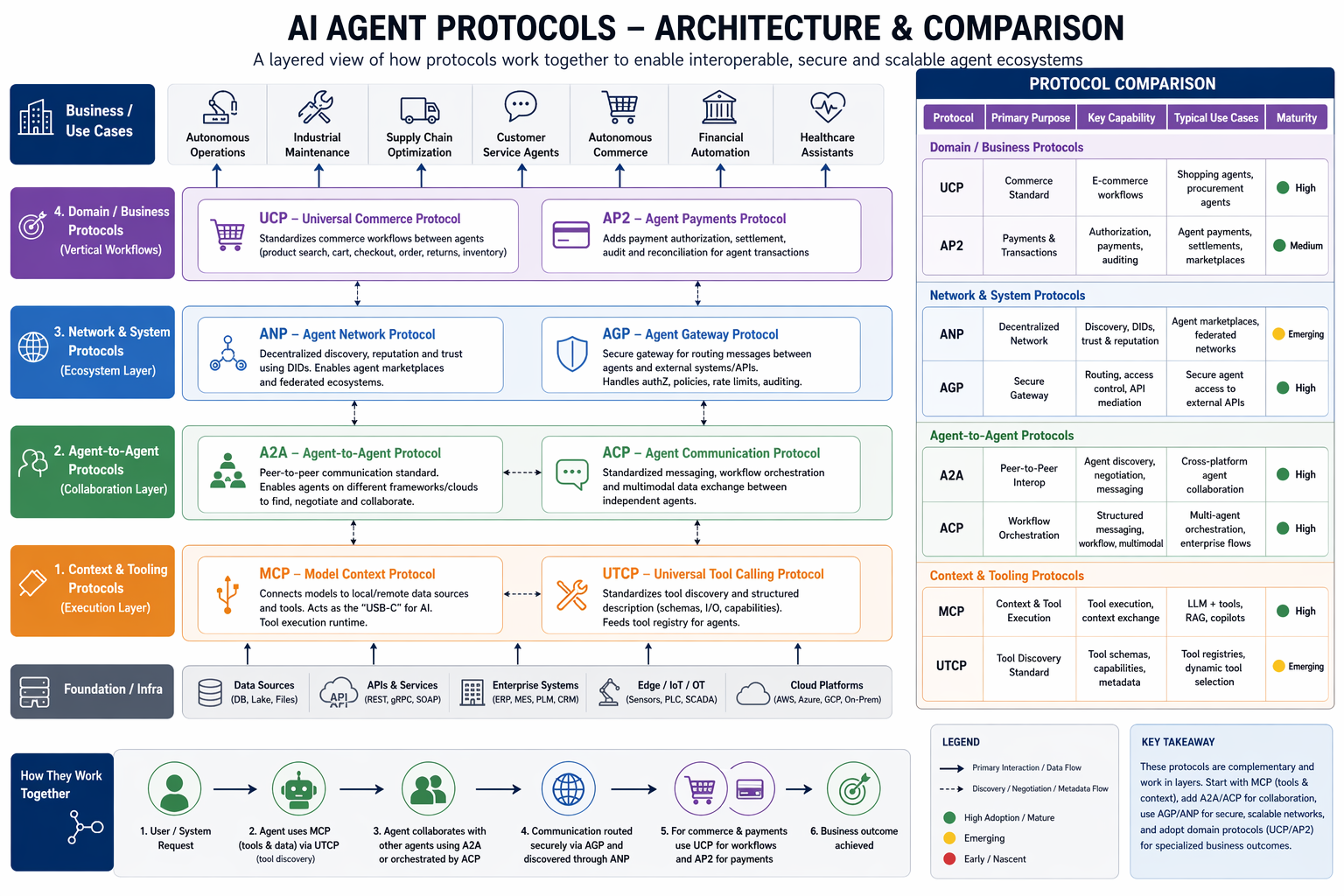
Not Only MCP: MCP, UTCP, A2A, ACF, ANP, AGP, UCP, AP2
AI Agent Protocols: A Layered Overview
AI agent protocols are emerging standards that enable interoperability between models, tools, agents, and enterprise systems. They solve the “connective tissue” problem, allowing AI systems to operate as coordinated, scalable ecosystems rather than isolated components.
🔌 Context & Tooling Protocols
These protocols enable a single agent to interact with tools, data, and APIs.
Model Context Protocol (MCP)
MCP acts as the execution backbone for tool usage. It provides a standardized way for AI models to connect to local data sources, enterprise systems, and external APIs. Often described as the “USB‑C for AI”, it handles runtime tool invocation and context exchange.
Universal Tool Calling Protocol (UTCP)
UTCP complements MCP by defining how tools are described and discovered. It standardizes tool schemas, metadata, and capabilities, enabling dynamic tool selection and reuse across agents.
🤖 Agent-to-Agent Protocols
These enable multiple AI agents to collaborate across platforms and frameworks.
Agent-to-Agent (A2A)
A2A provides a lightweight, peer-to-peer communication standard. It allows agents to discover each other, negotiate tasks, and exchange messages, making it ideal for decentralized collaboration.
Agent Communication Protocol (ACP)
ACP extends A2A by adding structured messaging and workflow orchestration. It supports complex multi-agent systems, including task coordination, multimodal communication, and enterprise-grade workflows.
🌐 Network & System Protocols
These protocols manage infrastructure, security, and scalability in distributed agent ecosystems.
Agent Network Protocol (ANP)
ANP enables decentralized agent networks using identity, discovery, and trust mechanisms (often based on decentralized identifiers). It is key for federated systems and agent marketplaces.
Agent Gateway Protocol (AGP)
AGP acts as a secure gateway between agents and external systems. It handles routing, authentication, access control, and policy enforcement, ensuring safe and scalable integration with APIs and enterprise services.
🛒 Domain-Specific Protocols
These protocols standardize vertical business workflows.
Universal Commerce Protocol (UCP)
UCP defines how agents perform end-to-end commerce operations, including product search, cart management, checkout, and order handling. It enables autonomous purchasing agents.
Agent Payments Protocol (AP2)
AP2 adds a financial layer, supporting payment authorization, auditing, and transaction management between agents. It ensures trust and compliance in automated transactions.
🏗️ Key Takeaways
- AI agent systems are layered architectures, from tool integration to business workflows
- MCP is foundational, enabling tool execution
- A2A and ACP drive collaboration, with ACP suited for enterprise orchestration
- ANP and AGP enable scalable, secure ecosystems
- UCP and AP2 unlock real business value through automation of commerce and payments
🚀 Conclusion
Modern AI systems are evolving toward interoperable, multi-agent platforms. Rather than choosing a single protocol, real-world architectures combine them into a layered stack: